Max Mara Coats: The 101801, Manuela, Teddy Bear and Ludmilla, and Which to Buy
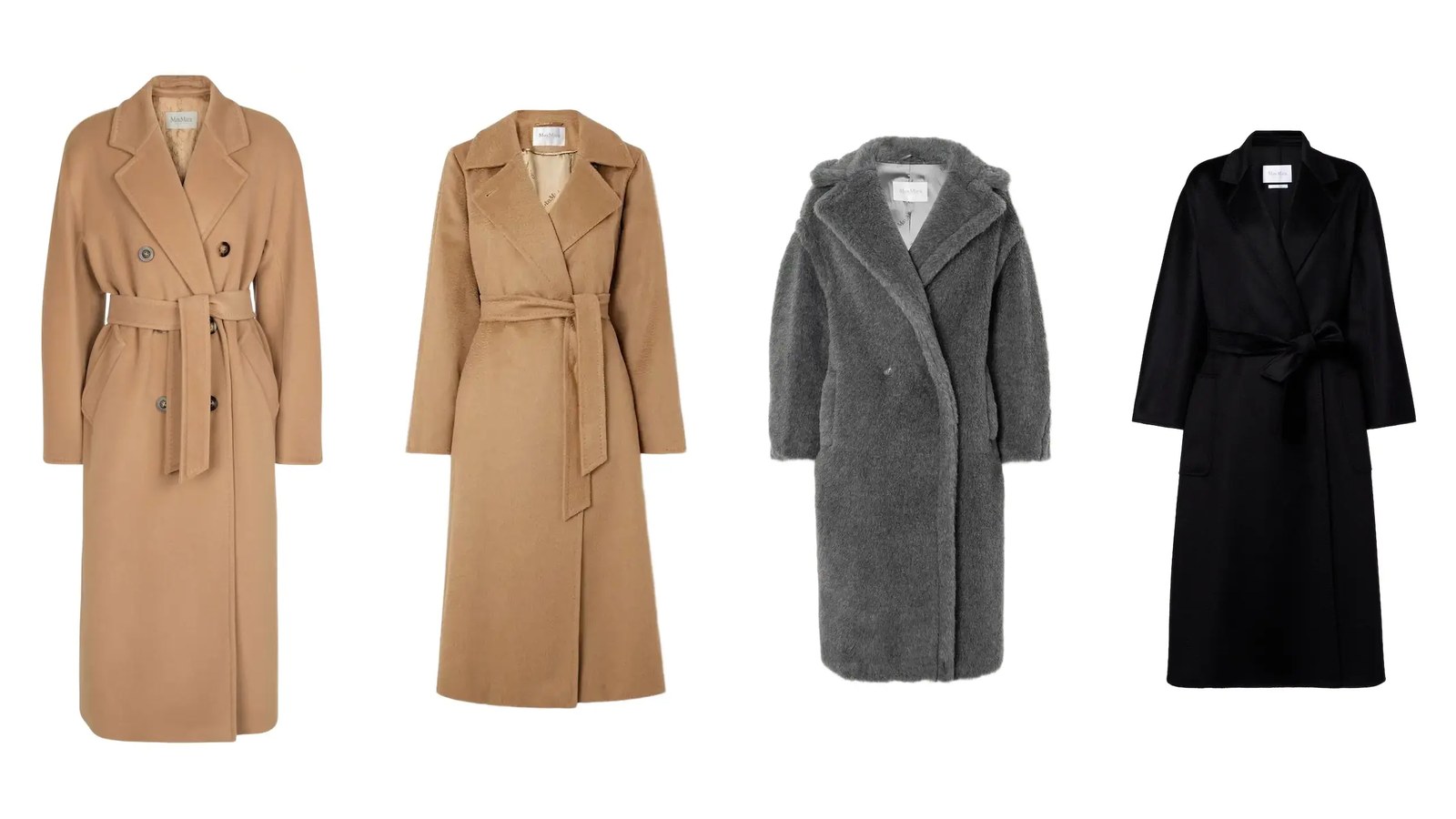
The Max Mara coats worth knowing come down to four icons, and choosing between them is mostly a matter of cloth and cut. The 101801 is the double-breasted wool and cashmere coat Anne-Marie Beretta designed for the house in 1981; Max Mara's own product pages give its style name as Madame. The Manuela is a belted robe coat in pure camel hair, which the house dates to 1998 and also credits to Beretta. The Teddy Bear is the deep-pile coat Ian Griffiths designed in 2013, and the Ludmilla is an unlined wrap in pure cashmere. If you are buying one this fall, choose the 101801 for one coat that goes over everything, tailoring included; the Manuela if you live in knitwear; the Teddy for real cold; the Ludmilla for cashmere. Below: how each is cut and who it suits, lengths, fibers, Italian sizing, coats under $2,000 and care.
Max Mara: a coat house since 1951
Achille Maramotti founded the first company of what became the Max Mara group in Reggio Emilia in 1951, and the tailoring came with the family. The Max Mara Fashion Group traces it to a major workshop that Marina Rinaldi, the founder's great-grandmother, ran in the center of the city in 1850, and to her granddaughter Giulia Fontanesi Maramotti, whose work in sewing and patternmaking from 1925 included a series of volumes on the "theory of cutting" (Max Mara Fashion Group history).
The coat is what the house is known for: for its 55th anniversary in 2006 the group opened an exhibition called COATS! Max Mara, 55 years of Italian fashion at the Kulturforum in Berlin, and later took it to Tokyo, Beijing, Moscow and Seoul. The group's other labels include Sportmax, Weekend Max Mara and Marina Rinaldi, and Max Mara itself sells several collections, among them 'S Max Mara, which the group dates to 1998, and Max Mara Studio. All four icons below carry the main Max Mara label; under $2,000, you will often be buying from one of the other collections.
The Max Mara 101801 coat, and why it is also called Madame
The 101801 is the coat Max Mara describes as its most widely recognized garment. Anne-Marie Beretta designed it for the autumn/winter 1981 collection, and the house still sells it. It also goes by a second name, so to be clear: Madame and 101801 are the same coat. Max Mara markets it as the 101801 Icon Coat, but its product pages pair that number with the style name Madame; on the camel coat the product code reads 1018016006001 - MADAME (Max Mara's 101801 product page). Retailers use either name, or both.
What makes it recognizable is the cut: a double-breasted front and oversized kimono sleeves made to be turned up to the length of your arm. The house lists a beaver cloth of 90 percent virgin wool and 10 percent cashmere, tailored stitching, a lapel collar, welt pockets, horn buttons, a matching belt and a cupro-blend lining. The long coat measures 120 centimeters, about 47 inches, and comes with a wooden hanger and a canvas garment bag. There is also a Short 101801 Icon Coat, style name Rebus: the same cloth and turn-back sleeves, cut to end above the knee.
The built-in volume goes over a blazer or a chunky knit without strain, and because kimono sleeves have no set-in shoulder, the coat neither hangs off narrow shoulders nor pulls across broad ones. Camel is the color to buy first; black and the deep navy the house calls ultramarine are the city alternatives.
- Camel 101801 over a gray flannel trouser suit, with chocolate suede loafers. It sits over the jacket without crushing it, and the camel warms up the gray.
- Belted over an ivory turtleneck and a burgundy midi skirt, with brown knee boots. The coat covers the skirt, so let the boots disappear under the hem.
- Open over a white T-shirt and ecru or white jeans, belt tied behind you. Push the sleeves back to show a watch.
- Short 101801 over wide-leg trousers that break on the shoe. A short, full coat over a long, full leg keeps a petite frame in proportion.
The Max Mara 101801, long and short


The Max Mara Manuela: the camel-hair robe coat
The Manuela is the house's belted robe coat in pure camel hair. Max Mara dates it to 1998, credits it to Anne-Marie Beretta and describes the cloth as a sable-look pure camel broadcloth (Max Mara's Manuela product page). WWD, covering the house's coat exhibition in Seoul in 2017, put its launch in the 1990s and reported that, according to Max Mara's fashion director, Laura Lusuardi, it was still one of the best sellers along with the 101801.
Its details are quieter than the 101801's: a straight fit rather than an oversized one, hand-stitched tailoring detail, shirt-style armholes on a kimono sleeve, pockets set into the side darts, a matching belt and a viscose lining. The wide collar has what the house calls a 2-in-1 button, so it can lie open as lapels or close at the neck against the wind. The length is 115 centimeters, about 45 inches.
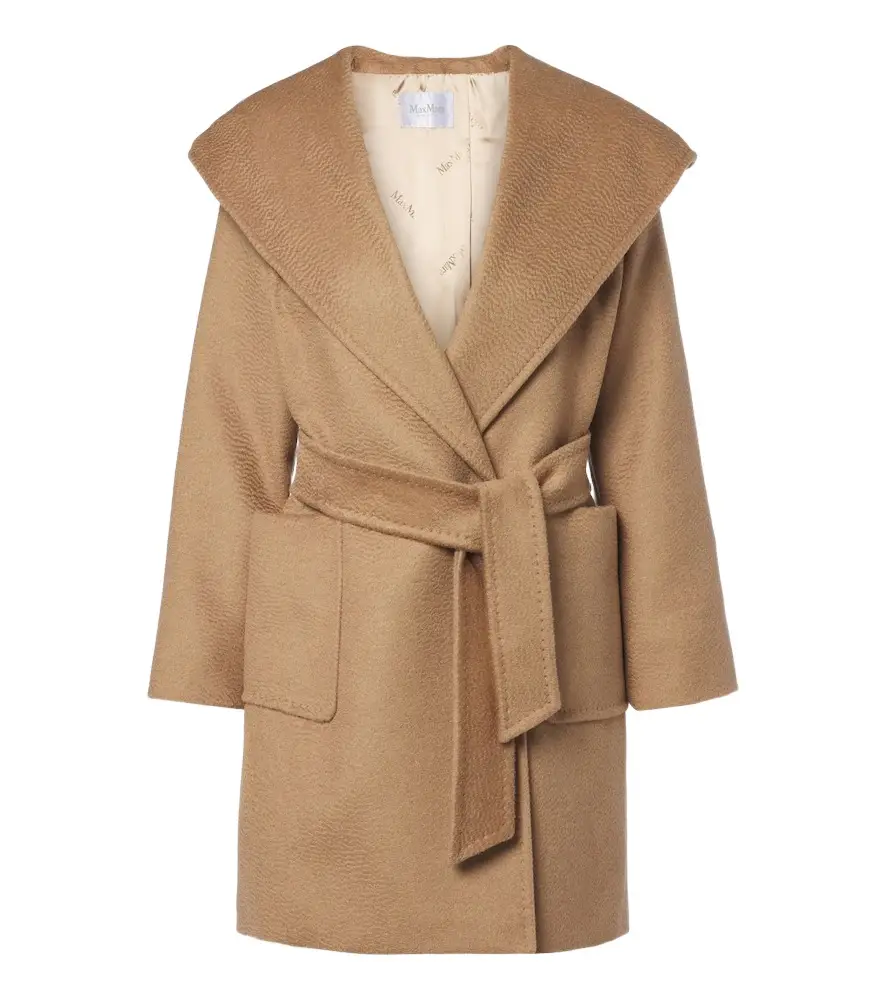
Because it wraps rather than buttons, the Manuela adjusts to a thick sweater: you simply cross it less, and the lining lets it slide over the knit (our guide to judging a cashmere sweater covers the knits). Camel hair also gives it a softer, deeper surface than wool. It is also the one icon cut straight rather than oversized, so if you wear a blazer under your coat most days, try it over one before you settle on a size. Want a hood? The house also makes hooded camel-hair robe coats, such as the Rialto, in the same sable-look broadcloth; one closes the edit below.
- Camel Manuela over an ivory cable knit, cream wool trousers and brown suede boots. Tonal from collar to hem, with the belt tied loosely over the bulk.
- Black Manuela, black turtleneck, gray flannel trousers, black loafers. Dark on dark lets the texture of the camel hair do the work.
The Max Mara Manuela, and a hooded camel-hair wrap


The Max Mara Teddy Bear coat
The Teddy Bear coat was introduced on a Max Mara runway in 2013. Its designer, Ian Griffiths, who is also the house's creative director, told The New York Times in 2019 that he remembered "a certain type of coat in the '80s made from rich, deep pile" and felt that kind of coat was missing. Its first season brought a modest burst of popularity, mostly thanks to street-style photographs of the French editor Carine Roitfeld wrapped in one in Milan; Griffiths then returned it to the runway and built the fall 2017 collection around a version in silk and camel hair. By early 2019 it had sold more than 17,000, according to a company spokesman quoted by the paper (The New York Times on the Teddy Bear coat).
Today's Teddy Bear Icon Coat is a pile of camel hair, or of alpaca and wool, set on a silk base, a fabric the house calls a faux fur; the camel version is 88 percent camel hair and 12 percent silk. It is oversized, double-breasted and lined, with low-set sleeves and a length of 110 centimeters, about 43 inches, and a short version stops above the knee. Unlike the tailored icons, it comes in letter sizes, XS to L.
It is the Max Mara coat we would choose for the coldest days, and the most casual. The pile adds visible bulk, so it wants slim layers underneath and flat boots or sneakers rather than a structured blazer. If you would rather have sheepskin, our guide to the best shearling coats explains how real shearling, faux fur and teddy pile differ.
- Camel Teddy, gray sweatshirt, ecru jeans, chocolate lug-sole boots. The weekend formula it was made for.
- Gray or black Teddy over all black: a fine knit, wide trousers and ankle boots, for the evening.
The Max Mara Teddy Bear coat, long and short
 Max MaraTeddy Bear Icon camel hair and silk coat$4,670
 Max MaraTeddy Bear Icon Oversized Wool, Alpaca And Silk-blend Coat - Gray$4,460
 Max MaraWomen's Teddy Bear Icon Coat in Alpaca and Wool - Beige$4,460
 Max MaraWomen's Teddy Bear Icon Coat in Alpaca and Wool - Black$4,460
 Max MaraTeddy Bear Icon alpaca, wool, and silk coat$4,460
 Max MaraWomen's Short Teddy Bear Icon Coat$3,890
The Ludmilla: Max Mara's pure cashmere icon
If you want cashmere, the Ludmilla is the Max Mara icon to look at. The house describes it as a classic from the Max Mara wardrobe, reinterpreted in 2016 and reintroduced in every collection since: a generous wrap with a matching belt, large patch pockets, and sleeves cut kimono-style at the front and raglan at the back. It is made of pure cashmere double cloth, two layers joined and stitched by hand, it is unlined, which lets it drape softly, and it measures 120 centimeters. Our guide to the best cashmere coats explains how double-face construction works and what a cashmere label must tell you.
That construction has two practical consequences. With no lining, textured sweaters drag on the cloth, so wear it over smooth knits and silk. And because double cloth is finished by hand at every edge, shortening the hem is a specialist job: judge the length in the fitting room rather than planning to alter it. Tie the belt loosely at the side so it does not crease the front.
- Black Ludmilla over a black cashmere turtleneck and an ivory silk slip skirt, with black knee boots. Smooth layers let the cashmere fall straight.
- Gray Ludmilla, cream crewneck, charcoal trousers and white leather sneakers, with the belt tied at the side.
The Ludmilla in pure cashmere


Which Max Mara coat to buy: 101801, Manuela, Teddy or Ludmilla
| Coat | Cloth, as the house describes it | Cut | Lining | House length | Sizing | Buy it if |
|---|---|---|---|---|---|---|
| 101801 (Madame) | 90% virgin wool, 10% cashmere beaver cloth | Oversized, double-breasted, turn-back kimono sleeves, belt | Lined | 120 cm (about 47 in); a short version ends above the knee | US 0 to 16 | You want one coat to wear over everything, suits included |
| Manuela | Pure camel broadcloth, sable-look finish | Straight, belted wrap, kimono sleeve cut | Lined | 115 cm (about 45 in) | US 0 to 16 | You live in knitwear and want the softest camel |
| Teddy Bear | Camel hair, or alpaca and wool, pile on a silk base | Oversized and double-breasted, low-set sleeves | Lined | 110 cm (about 43 in); a short version ends above the knee | XS to L | You need warmth and dress casually |
| Ludmilla | 100% cashmere double cloth, stitched by hand | Generous belted wrap, kimono front, raglan back | Unlined | 120 cm (about 47 in) | US 0 to 16 | You want pure cashmere that drapes, over smooth layers |
If you can own only one, make it the 101801 in camel: it is the most flexible of the four and has the longest record. The Manuela is the better choice if you wear sweaters more than suits; the Teddy is a second coat for cold snaps rather than a first; the Ludmilla is the softest of the four, and the one that asks the most care.
- Under about 5 feet 4 inches: start with the Short 101801 or the short Teddy, which keeps the texture without the weight; the long icons can swamp a small frame. If you want a long coat, the belted Manuela breaks up the length better than a 101801 worn open.
- Tall: every long icon works, and the long Teddy's volume reads as deliberate rather than overwhelming.
- Full bust or curves: a belted wrap, the Manuela or the Ludmilla, marks the waist and gives a cleaner line than a double row of buttons.
- Narrow or broad shoulders: the kimono-cut sleeves of the 101801 and the Ludmilla have no set-in shoulder to fit, so they forgive either, and the Manuela's relaxed, shirt-style armholes come close.
Max Mara's icon page now also shows a fifth coat, Ready, which the house calls its latest icon wrap coat: a belted wrap in unlined, double-faced pure camel hair with a raglan cut. It is too new for us to judge how it wears over several winters, so it is not one of our four.
How long should a Max Mara coat be?
The house gives 120 centimeters (about 47 inches) for the 101801 and the Ludmilla, 115 (about 45) for the Manuela and 110 (about 43) for the Teddy. To see where that lands on you, measure a coat you already own from the collar seam at the back of the neck to the hem and compare: a 47-inch coat that ends at mid-calf on a tall woman can reach almost to the ankle on a shorter one. Then match the hem to what you wear under it:
- Knee boots: the coat should cover the top of the shaft; a band of tights between boot and hem breaks the line. Our guide to knee-high boots that fit covers shaft heights and calf widths.
- Ankle boots: wear trousers long enough to meet the boot, straight or wide, so the line runs unbroken from coat to shoe. Cropped trousers under a long coat leave a stripe of ankle.
- Skirts and dresses: the hem should sit well inside the coat or clearly below it, never an inch or two beyond it.
- Short coats: the Short 101801 and the short Teddy look best over a full-length leg, such as wide trousers that break on the shoe or ecru or white jeans with boots.
Camel hair, wool or cashmere: what the fiber changes
The Cashmere and Camel Hair Manufacturers Institute, the trade body for both fibers, sets out the basics (CCMI's fiber facts). Camel hair is the fine undercoat of the two-humped Bactrian camel; the coarser outer guard hair is removed before spinning. For a coat, three differences matter:
- Surface. The institute describes camel hair and cashmere alike as soft, with high napability and loft, which is to say they take a brushed finish well. That suits the Manuela's sable-look camel broadcloth and the Ludmilla's zibeline cashmere.
- Warmth. All three are natural insulators that stay light for their warmth, according to the institute, which also credits camel hair with thermostatic qualities that protect the animal in both mountain cold and desert heat. In a coat, the density of the cloth and the length count as much as the fiber.
- Structure. Wool's crimp gives a cloth elasticity and resilience, the institute notes, which helps the 101801's mostly wool beaver cloth hold its shape, while pure camel hair and pure cashmere drape more softly.
In real weather, the way a coat closes matters too. The double-breasted 101801 and Teddy close across the chest; the two wraps rely on the belt and leave a V at the neck to fill with a scarf, unless you button the Manuela's collar up. None of the four is a raincoat: shake off snow, let the coat dry and brush it, and in steady rain wear a trench instead (see how to wear a trench coat). The softer fibers also wear faster where they rub, so expect cashmere and camel hair to pill or shine first under the arms and wherever a bag strap sits.
The institute recommends camel hair either pure or blended with wool only, and it notes that a woven blend with nylon, or a wool, nylon and camel mix, may indicate lower-quality recycled fiber. Read the composition line before you buy any camel coat, from Max Mara or anyone else.
Max Mara sizing: Italian sizes and how the house cuts
The size guide linked from Max Mara's coat pages, which the house calls an approximate conversion, puts an Italian 38 at a US 4, an Italian 40 at a US 6 and an Italian 42 at a US 8; in other words, subtract 34 from the Italian size (Max Mara size guide). The same chart pairs XS with an Italian 36 (US 2), S with 38 (US 4), M with 42 (US 8) and L with 46 (US 12), which is how to read the Teddy's letter sizes, and puts a UK size two above the US one. Not every Italian house converts the same way, so use Max Mara's chart. On the house's US site the 101801, the Manuela and the Ludmilla come in US sizes 0 to 16, and the Teddy in XS to L.
The 101801, the Teddy and the Ludmilla are oversized by design, so choose your usual Max Mara size rather than sizing up for a jacket underneath. The straight-cut Manuela is the one to try over the layer you wear most, and in the next size up if you live in blazers. Whatever the model, check three things in the mirror:
- The front. Over your usual layer the lapels should lie flat and the coat should close or wrap without pulling. The relaxed shoulders are part of the design, so judge the fit here rather than at the shoulder.
- The back. Reach forward with both arms as if for a steering wheel; if the cloth strains across your shoulder blades, go up a size.
- The sleeve. The 101801's kimono sleeves are made to be turned back, so a slightly long sleeve is not a reason to size down.
Max Mara coats under $2,000: check which line you are buying
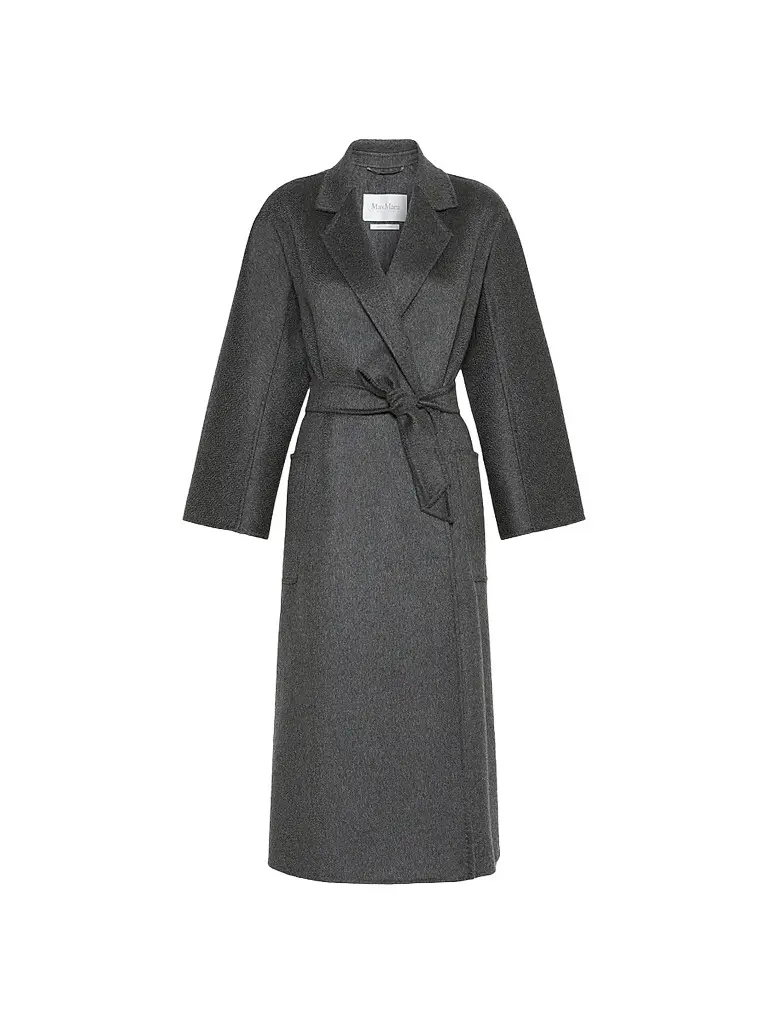
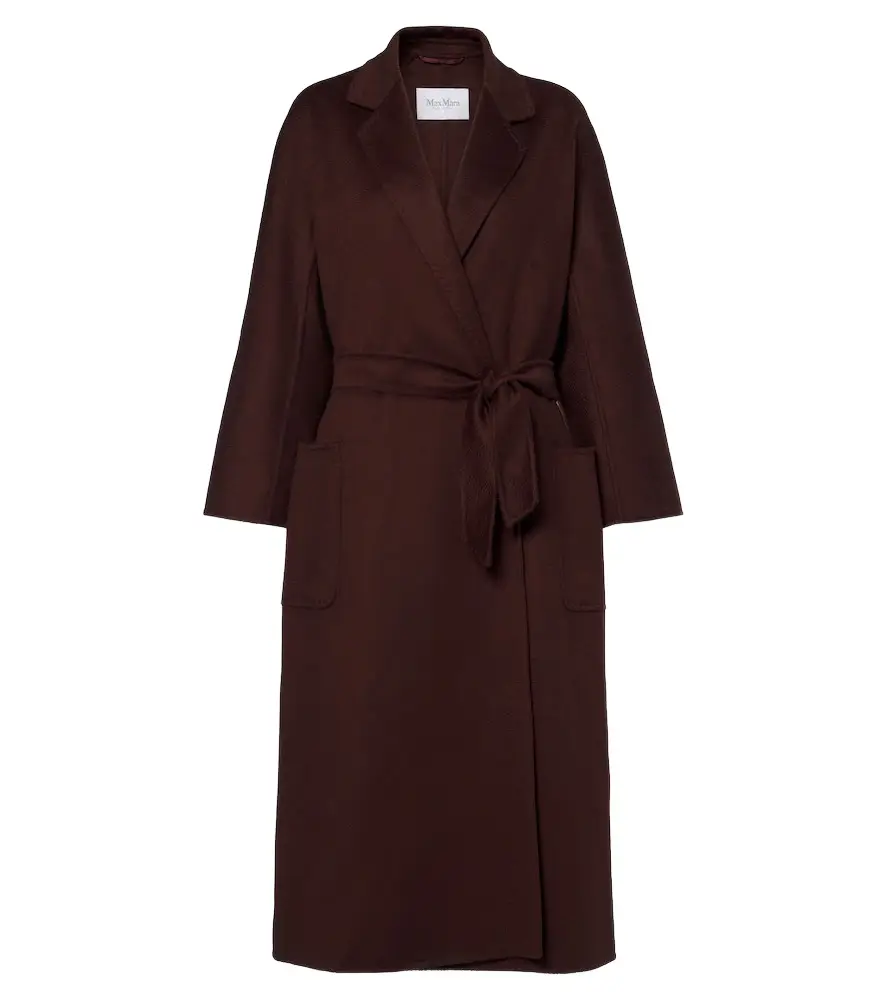
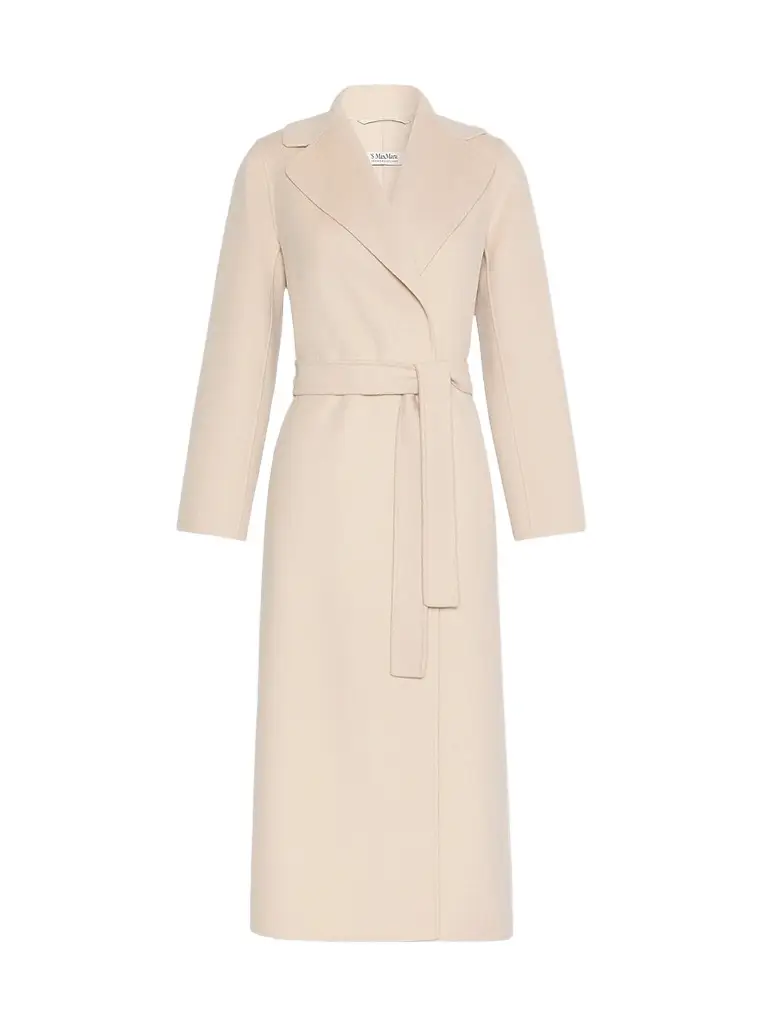
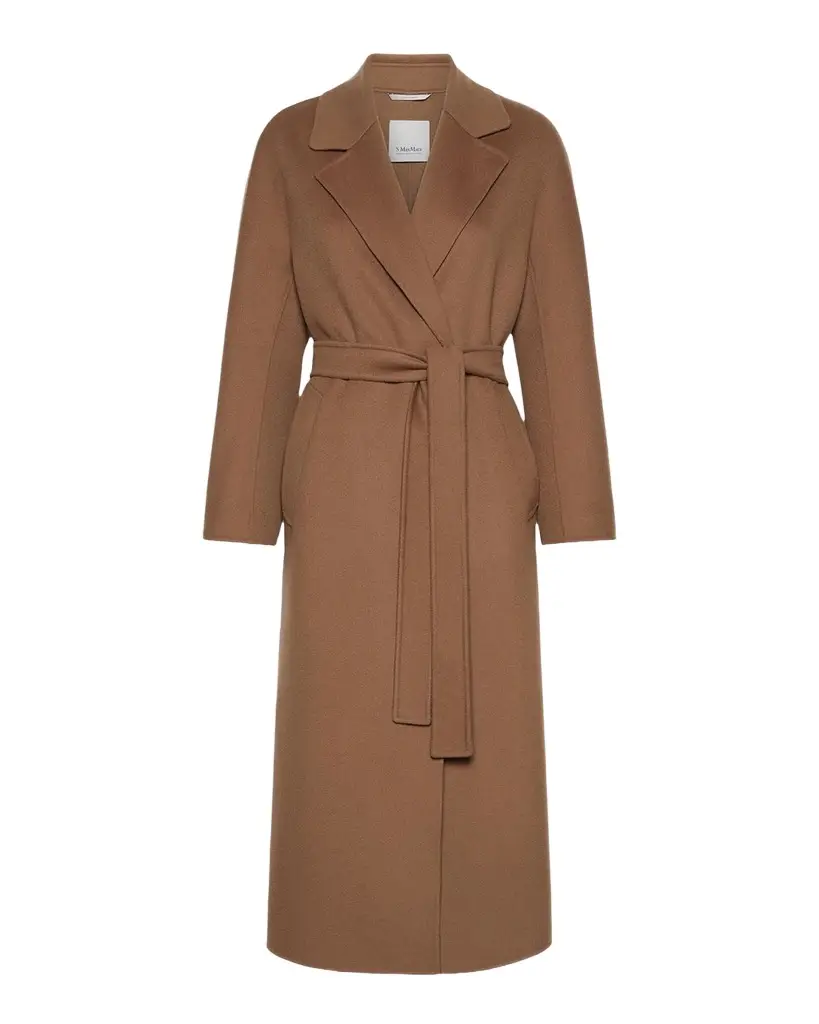
Under $2,000 you are usually buying wool rather than camel hair or cashmere, often hand-sewn double-face wool: two layers of cloth woven together and finished by hand at the edges, so the coat needs no lining. These coats are a way into the house's shapes for less, from robe coats with kimono sleeves to straight wraps and short cocoon cuts. At this price, though, a coat often comes from one of the group's other collections, even when a retailer lists it simply as Max Mara: on Max Mara's own site, the Poldo wrap and the double-faced robe coat in this edit are sold as 'S Max Mara. Nothing is wrong with that, but read the label inside and the composition line before you buy, and do not expect the icons' camel hair or cashmere.
Under $2,000: double-face wool from the Max Mara group



How to care for a camel hair coat
Start with the label. Max Mara's care instructions for all four icons say not to wash, bleach or tumble dry, and to use a professional dry cleaner with a mild process rather than wet cleaning. The 101801, the Manuela and the Ludmilla can take a cool iron, never over the 101801's buttons; the Teddy should not be ironed at all. The CCMI gives the same advice for any woven camel hair or cashmere: dry clean it. Between cleanings:
- Brush it. A soft clothes brush, used in the direction of the nap after each wear, lifts dust before it settles and keeps a brushed finish smooth.
- Hang it properly. Use a broad wooden hanger that fills the shoulders; the 101801 comes with one and with a canvas garment bag, so use both.
- Let it dry slowly. After rain or snow, shake the coat, hang it at room temperature and keep it away from radiators until it is dry.
- Clean it before storing it. Moths go for worn, unwashed wool and hair fibers, so have the coat cleaned before it goes away for summer, then keep it in a breathable cotton bag rather than plastic.
- Protect the Teddy's pile. Friction flattens it, so carry your bag in your hand rather than on a strap across the front, and never press it.
Not sure which icon suits the rest of your wardrobe? Ask our AI stylist to build outfits around a Max Mara coat before you choose.
How we chose
We started from the house's own description of each icon and kept only listings whose photographs show that model: the 101801's double row of horn buttons and turned-back sleeves, the Manuela's wide collar and belt, the Teddy's deep pile, the Ludmilla's patch pockets. Listings that contradicted themselves stayed out, among them a coat described as both cashmere and pure virgin wool, and a wool wrap whose listing said to hand wash it. We preferred the widest size runs; at the end of September two Ludmilla colors were down to a single size and most Teddy colors to three or four. Nothing in this guide is pre-owned.
Frequently asked questions
What is the most famous Max Mara coat?
The 101801, designed by Anne-Marie Beretta for autumn/winter 1981. Max Mara calls it its most widely recognized garment and still sells it as the 101801 Icon Coat.
Is the Max Mara Madame coat the same as the 101801?
Yes. Madame is the style name Max Mara's product pages pair with the coat's number, while the house markets it as the 101801 Icon Coat, so retailers use either name or both. The short version is the Short 101801 Icon Coat, style name Rebus.
Does Max Mara run large?
The 101801, the Teddy and the Ludmilla are cut oversized on purpose, but the sizes follow Max Mara's chart, where an Italian 38 is a US 4. Choose your usual size for those three; try the straighter Manuela over the layer you wear most.
Is the Max Mara Teddy Bear coat real fur?
No. It is a pile of camel hair and silk, or of alpaca, wool and silk, which the house itself calls a faux fur; there is no skin or pelt. It is also the warmest of the four icons, and too bulky to wear over a blazer.
What is the difference between Max Mara, 'S Max Mara and Weekend Max Mara?
Max Mara is the main line, and all four icons carry its label. 'S Max Mara is one of the house's other collections, which the group dates to 1998; its coats, such as the Poldo wrap, are priced well below the icons. Weekend Max Mara, launched in 1983 as a casual weekend collection, is the group's more relaxed label. Retailers do not always name the line, so check the label inside.
How do you clean a Max Mara coat?
Take it to a professional dry cleaner and ask for a mild process; Max Mara's care instructions say not to wash, tumble dry or wet clean its icon coats. Brush it between wears, and have it cleaned before you store it for summer.
Keep reading
- The best cashmere coats, and what the label must say
- This season's coat trends and the shapes worth buying
- The best shearling coats, and how to tell real from faux
- Knee-high boots that fit, to wear under a long coat
- The Edit: the best coats of the season
Shop more: all coats, belted coats and teddy, shearling and faux-fur coats, or compare camel and cashmere coats from Loro Piana, Brunello Cucinelli and The Row.